The significance of examinations lies far beyond assessing theoretical knowledge; it also evaluates knowledge retention and understanding of topics. Therefore, ensuring the integrity and transparency of assessments is a top priority in the South African education system.
Traditional examination systems include manual preparation, implementation, and result distribution, making them prone to unintended errors and drawbacks. Regulatory bodies like Umalusi have established a set of standards, requiring institutions to maintain them to carry out fair and honest examinations. Hence, educational institutions can leverage modern digital solutions to align with Umalusi’s quality assurance framework.
Umalusi’s Examination Quality Requirement
Umalusi’s responsibilities include developing and maintaining assessment and curriculum standards, thereby establishing consistency across all registered educational providers. On the other hand, it carries out rigorous quality assurance mechanisms for national examinations.
What’s more, it establishes a set of benchmarks, requiring educational institutions to comply accordingly for the examination lifecycle, and it includes the following:
Ensure the security of question paper setting and moderation.
- Standardized assessment processes
- Effective evaluation and moderation methods
- Transparent result processing and reporting
- Audit-ready documentation and traceability
Reliance on legacy systems and manual processes tends to be two of the primary factors behind recurring errors and data silos, affecting institutions’ chances of complying with UMALUSI. Digital examination systems can help considerably by helping institutes streamline core processes and adhere to the standards.
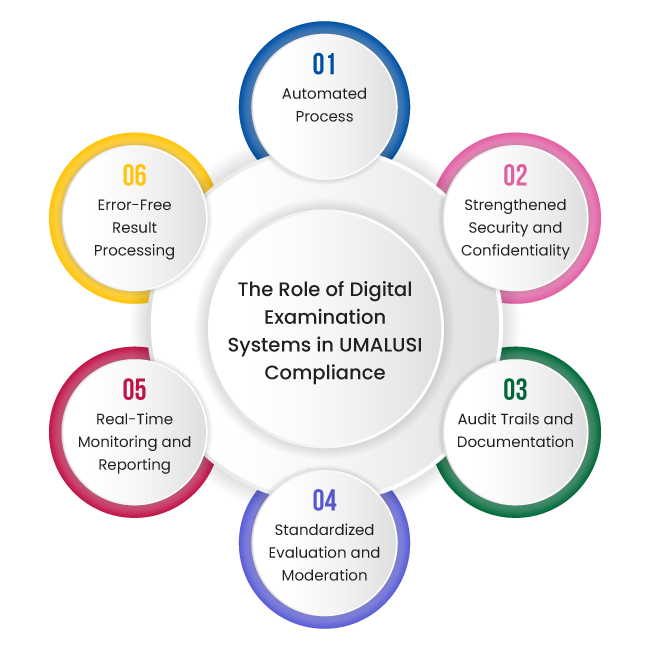
The Role of Digital Examination Systems in UMALUSI Compliance
Automated Process
Some South African colleges and universities rely on disconnected systems to carry out exam scheduling and paper management, leading to logistical issues. For instance, timetable clashes or last-minute changes during peak examination periods are notable bottlenecks that not only confuse students but also create additional workload for staff.
Digital platforms like MasterSoft's examination management system consolidate the pre-assessment procedures, helping to structure exam scheduling and paper setting. In effect, it reduces the administrative inconsistencies that may affect compliance.
Strengthened Security and Confidentiality
Recurring incidents of question paper leaks across national and provincial examinations compromise the integrity of the examination. These issues are increasingly common when institutes handle and distribute question papers manually.
In contrast, MasterSoft leverages security mechanisms, like encryption and role-based access control, that secure question papers from online threats and vulnerabilities. Also, it resolves the issues associated with physical storage and transportation across several institutions.
Audit Trails and Documentation
Institutions must produce several documents during an audit, including examination planning and policy documents, question paper and moderation reports, security and confidentiality reports, candidate and examination administration records, etc. Compiling all these documents in a paper-based format makes it prone to incomplete documentation or unintended errors.
Digitized documentation successfully eliminates such issues by logging each step, from paper moderation to result approval. In effect, institutions get accurate, tamper-proof documentation, thereby reducing the last-minute audit pressure and increasing institutional transparency.
Standardized Evaluation and Moderation
Marking or scoring is a significant part of the evaluation process that must follow the pre-established standards. Marking variability is a common pattern that has been seen across satellite campuses in South Africa, causing discrepancies. The solution lies in digital evaluation tools, which establish uniform marking schemes and moderation workflows.
Consequently, this helps institutions to comply with predefined academic benchmarks, irrespective of location, and it allows stakeholders to review flagged scripts or inconsistent grading patterns. Therefore, institutes can implement a fair and unbiased evaluation across diverse student groups.
Real-Time Monitoring and Reporting
Technical issues, logistical mistakes, absenteeism, etc. are common, and institute leadership may not be able to identify them readily during ongoing assessments. However, real-time dashboards enable admin staff to check the progress of ongoing assessments across different centers.
As a result, they can identify discrepancies promptly and take corrective steps to align with UMALUSI guidelines. Real-time monitoring proves to be useful, especially during high-stakes examinations, wherein technical issues and procedural delays disrupt the examination environment.
Error-Free Result Processing
Manual marking system and reconciliation mistakes cause delayed or inaccurate results, causing student dissatisfaction and delayed student progression, affecting institutional credibility. Leveraging the online tools can help institutions automate result calculation, ensuring accuracy and accelerating the result publication process.
Additionally, it facilitates timely re-evaluation procedures and reduces student grievances, which is a key area of consideration during quality assurance reviews.
Conclusion
Umalusi’s quality assurance standards are a set of clearly defined benchmarks and require institutions to maintain transparency and accuracy in their compliance mechanisms. This is where MasterSoft's examination management system can help generate, store, and organize records, increasing efficiency and supporting audit preparation
Click for a digitally empowered campus
 Author :
Gaurav Somani,
President Sales