War, pandemics, inflation, etc. impact the socio-economic and political landscape globally, affecting governance and commerce as well as education. Nevertheless, national initiatives strive to ensure the continuation of education by facilitating accessibility to learning.
Educational institutions follow state policies and guidelines and implement disaster management strategies to ensure student and faculty and staff protection. One of the decisive steps they adopt to ensure continuous education is online learning and technology-driven education.
But is technology-driven education as effective as traditional education, and does it ensure holistic student development? Let us find out:
Why is technology-driven education important?
Integrating technology in modern academic environments transforms passive learning by making learning effective and flexible. Modern tools like cloud-based digital solutions allow teachers to create and deliver diverse educational materials, catering to varying learning styles.
Technology-driven education has moved beyond a trend or alternative option; rather, it has become an important aspect of the 21st century academic curriculum. Modern tools and applications become increasingly important to provide guidance, especially during uncertain times.
The solution? Choosing a modern, scalable software that does not just automate repetitive functions but also helps to improve teaching and learning activities is important.
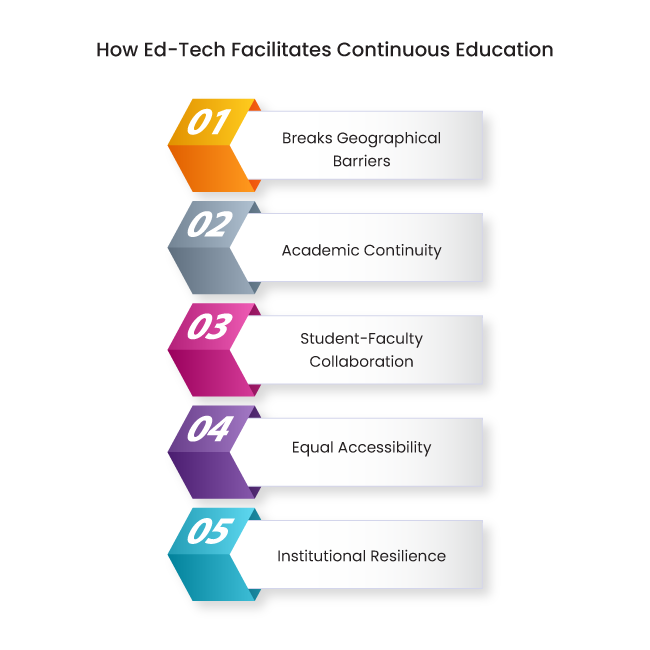
How Ed-Tech Facilitates Continuous Education
Breaks Geographical Barriers
Disruption of public transportation or temporary halting of day-to-day activities due to sudden global events or natural disasters demands strategic response and planning. Colleges and universities can use Mastersoft’s SIS platform to store, manage and share institutional information.
SIS provides a student profile, which learners can use to access course materials, assessments, microlearning exercises, etc. Institutes can conduct virtual classrooms and e-learning courses, allowing students to enrol from anywhere in the world.
Students from remote regions often struggle due to inadequate educational opportunities. Online learning platforms provide them access to higher educational opportunities, helping to upskill themselves and thrive in the 21st-century workspace.
Academic Continuity
Loss of data due to sudden power outages or cyber attacks can compromise sensitive institutional information, including student and financial data. However, most modern ERP software comes with cloud-based systems that store data securely.
The automated backup feature saves student records, financial data, examination reports, results, etc. on the cloud server. In effect, institutions can recover all data in case of accidental data deletion or technical failures.
Academic processes such as teachers uploading assignments, study materials, study notes, etc., can continue. On the other hand, students can access learning materials conveniently and get real-time updates on exams or classes.
Student-Faculty Collaboration
Digital or online classes lack interaction and can lead to social isolation is a common misconception that requires addressing. Teachers can utilise online platforms to foster collaborations among students.
This is where they can leverage modern learning management systems, which provide discussion forums, group workspaces, etc. Students can use the platform to brainstorm ideas, find solutions to problems, and engage in discussions.
At the same time, teachers can use the tool to provide timely feedback and interact with students actively, wherein the latter can ask questions. In effect, teachers can clarify doubts and provide guidance and motivate them.
Besides, when students engage with peers and faculty routinely, it helps to establish an interconnected learning environment.
Equal Accessibility
Geographically remote areas and conflict-affected regions hardly have proper educational facilities; students are unable to attend regular classes or pursue higher education. Higher educational institutions can expand their reach by providing digital learning courses.
Furthermore, the hybrid learning model is a unique education system that allows students to opt to attend classes and complete assignments as per their convenience. Students can also rely on mobile learning applications, recorded lectures and online educational materials.
Institutional Resilience
Adopting digital infrastructure is not just a strategic move to modernise institutions; it is a necessity to accelerate day-to-day operation. However, scalable software systems have become imperative for colleges and universities to strengthen institutional resilience across departments.
In effect, administrative and academic processes can continue undisturbed without little or no manual intervention. Also, the system provides data security, which is a top priority in the current scenario, when data breaches have become a common event.
Final Thoughts
Unprecedented events disrupt the educational process; ed-tech solutions like SIS software and integrated campus solutions can help to strengthen learning continuity. When colleges and universities adopt digital solutions, they can create a flexible and equal educational ecosystem.
Click for a digitally empowered campus
 Author :
Gaurav Somani,
President Sales